

Three dual-crystal probes ship with the payload: 2.25 MHz, 5.0 MHz and 7.5 MHz. The Scout 137 Gen 3 UTM Payload also supports single, twin, delay-line and high-temperature probe designs, and an optional three-probe single-crystal pack is available. You fit the probes ScoutDI supplies; customer-owned UT probes cannot be fitted.
This question came from an attendee at one of our Live Online Demos.
Why three frequencies
Ultrasonic Testing (UT) is a trade-off between penetration and resolution, so the right probe depends on the steel in front of you:
- 2.25 MHz dual-crystal for thick, coarse or rough surfaces
- 5.0 MHz dual-crystal, the standard general-purpose probe
- 7.5 MHz dual-crystal for thin material
All three run on the Thornetix Talisman, a high-speed, multi-channel embedded ultrasound module. You swap probes to match the job, not the other way round.
Probe choice is only half of it. The NDT technician controls gain, gates and delay in Scout Companion during the flight, with the payload still on the wall. No landing to change a setting.
Why dual-crystal?
A dual-crystal (twin) probe uses two separate elements: one transmits, the other receives. Because the receiver is not recovering from its own transmit pulse, the dead zone just below the surface is smaller and near-surface resolution is better than with a single element. That is why dual-crystal is the usual choice for corrosion work, where the remaining wall can be thin and the back wall rough and pitted. The two elements sit at a slight angle to each other, so the sound travels a shallow V-shaped path. The Thornetix Talisman UT module performs V-path compensation to correct for it.
Optional probes, and curved surfaces
The optional single-crystal pack adds three Thornetix probes:
- 2.25 MHz single crystal (Thornetix DRS225-10C)
- 5 MHz single crystal (Thornetix DRS5-10C)
- 10 MHz single-element delay line (Thornetix DR10-6)
On curved surfaces such as pipe, the delay-line and the 7.5 MHz dual-crystal probes are the best options, and surface condition decides between them. The 10 MHz delay line does best on thin, fairly clean walls. On corroded, pitted or coated pipe, the 7.5 MHz twin-crystal probe is the safer choice, because twin-crystal probes cope better with rough back walls and near-surface noise.
What the payload measures
- Thickness range 1 to 150 mm (material-dependent)
- Accuracy better than 0.1 mm or ±1 %, resolution 0.001 mm
- Peak, Edge and Multi-Echo modes, with coating exclusion (Modes 1, 2 and 3 per ISO 16809)
- Multi-Echo reads through coatings up to 6 mm
- Gain up to 80 dB, two measurement gates (manual or automatic), full A-scan waveforms logged for review
Watch the UTM Payload being calibrated and taking measurements in our Flight Lab:
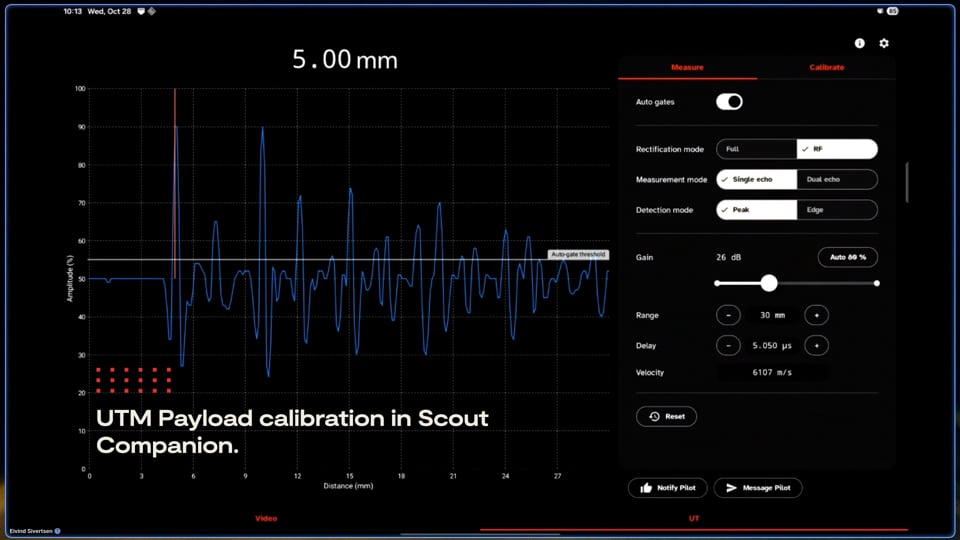 Vimeo2026-10-28 UTM calibration0:44
Proof
The payload is factory tested and calibrated to ISO 16831 / EN 15317, and supports 1- and 2-point field calibration through the app. Our customer Marine Inspection Services ran side-by-side comparisons between the drone and two handheld gauges; see integrated cleaning and UTM in one controlled operation. On the Shell “Turritella” special survey, the Scout 137 and the UTM Payload were integral data acquisition tools inside the cargo tanks.
Bring your thickness range and material to the demo and we will tell you which probe we would fly.